
Light Height is Important
Jan 17, 2026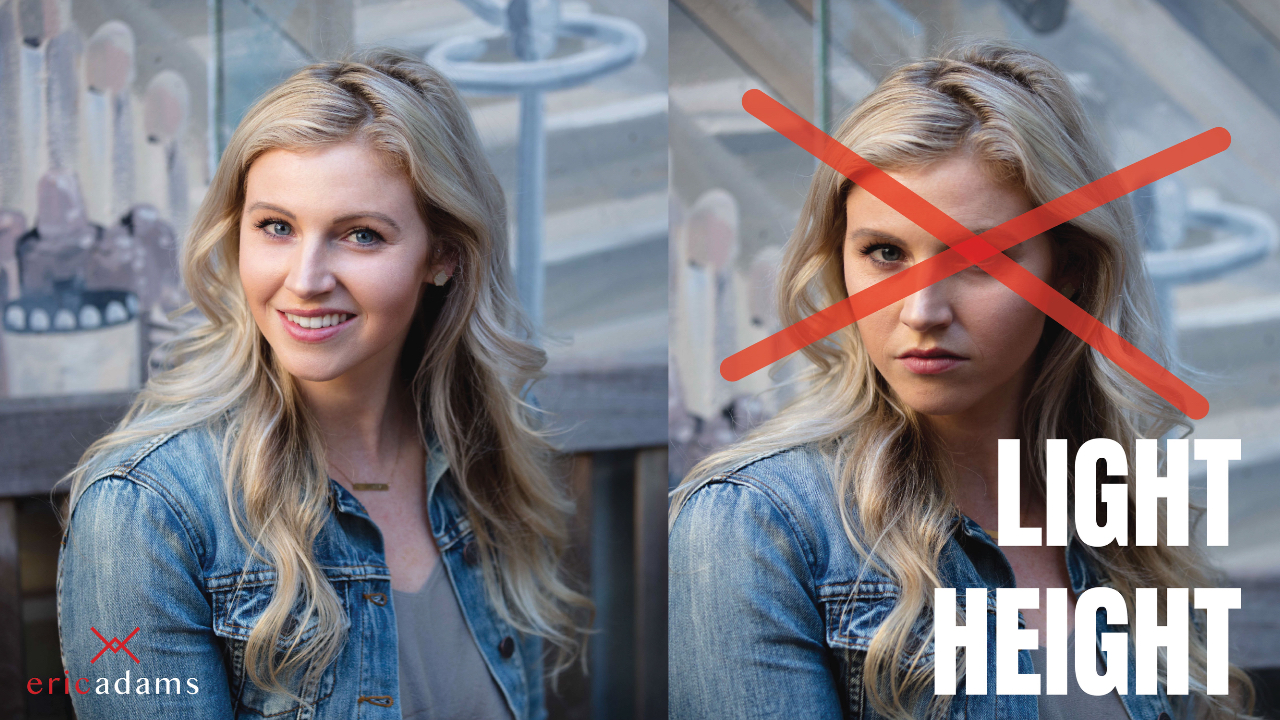
Light Height
Light Height Controls Feeling Too
Light angles that vary on a vertical axis also control the feeling of the image. Imagine an arc that starts at your subject’s feet and travels around to the crown of her head. As you move along that axis, the feeling changes.
Lower than Eye Level = Bad
When light is low, it almost always looks unnatural. As humans, we are used to light coming down from above to some degree - the sky, ceilings, etc. Very rarely do we experience light coming from below. Only when sharing scary stories in front of the fire or by holding a flashlight under our faces. It’s not something that we are used to - therefore, it looks unnatural.
I went to a dance club where the floor lit up. It occurred to me that this was a design flaw because everyone in the club looked horrible because the main light was coming from below. If people go to the club to attract others, it wasn’t going to work here. True story: the club shut down shortly after.
Light coming from below eye level creates some unflattering shadows and highlights. For example:
- Shadows on the tops of cheeks. Consider where women wear rouge, it’s under their cheeks. You con’t really see folks applying rouge to the tops of their cheeks. That would be weird - maybe crazy bag-ladies do it. In this same way, you don’t want to add shadow to the tops of your subject’s cheeks. Unless she’s a bag-lady.
- Highlights on the nostrils and jowls. Nostrils aren’t usually the attractive part of your face. I’ve never gazed into someone’s nostrils. Jowls aren’t something that should be highlighted. I can’t think of a person asking me for more pronounced jowls.

You want to pay attention to the subject’s catchlights. If the catchlights are in the 4:00-8:00 range in the subject’s eyes, your light source is too low in relation to her.
You also want to look at the direction of the subject’s nose-shadow. I cover this in detail when talking about sunlight. In this section I compare the nose shadow to a sundial. The nose shadow should be pointed downward to some degree. If it’s pointed upward on the subject’s face, it’s another indication that the light is too low.
Above Eye Level
Getting the light about 30º above the subject’s eye level will create some flattering, downward shadows. These shadows will:
- Enlarge the eyes by casting shadows from the eyelids/eyelashes. People consider bigger eyes more attractive. Ask any anime fan.
- Enhance the cheekbones by casting shadows on the cheeks below the cheekbones.
- Slim the face hiding jowls with the nose/lip shadows and by casting a shadow on the neck. Separating the face from the neck has a slimming affect. Just ask Mary Queen of Scots.

The problem of light height being too low or too high is very common. I've seen many photographers use reflectors or other light sources and hold them down below the subject's face. I've literally seen a photographer use a flashlight and point it at the girl from down low. It wasn't going to be a good result!